

Granted, I'm not trying to make a market on Facebook Marketplace, or get it to help me make bank, It is almost exclusively scanning email and calendar, things that, obviously, Google should be doing already.
Muse is wildly imperfect, with "side chats" that make no sense, inconsistency about what it just does on a vibe, and what you must demand it do, but ... still.
What Happened
Meta launched Muse last month as a personal AI agent designed to act across applications and services rather than simply answer questions. It quickly rose to the top of the Google and Apple app stores, as I've written here previously.
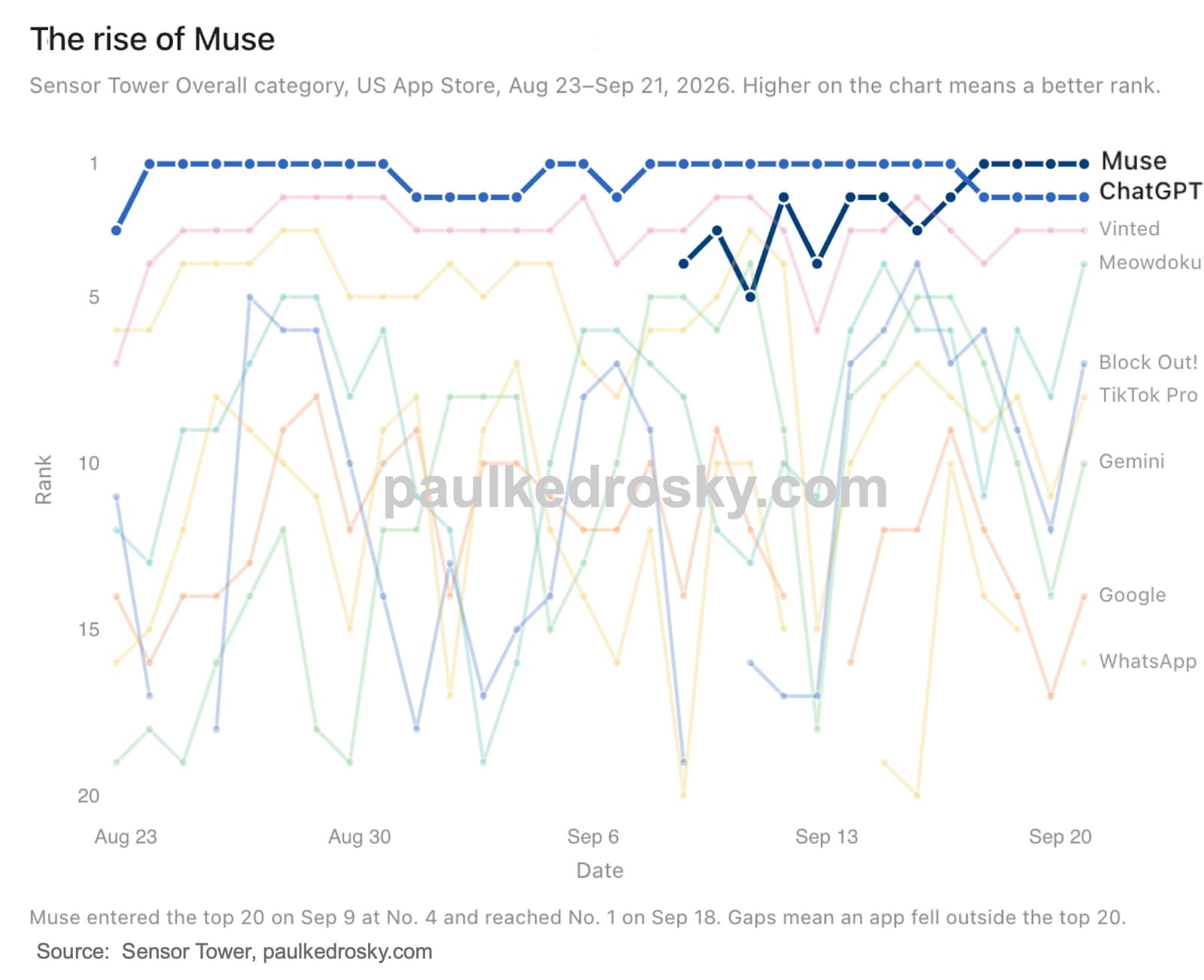
Muse can work with email, calendars, websites, and other services, use a browser, complete forms, and carry out multi-step tasks. Meta is also pushing it into business, where the agent can operate across some typical software and tasks.
What It Means
Despite all the noise around it, people mostly misunderstand what is happening. Muse's general invisibility is the important product change: Muse is the AI market shifting from a chatbot interface toward a more naturalistic, ambient presence that can take actions on a user's behalf, and let you know when it has. We are moving away from the opacity and arcana of coding harnesses toward something more fluid, persistent and less visible.
Muse shows the value in AI moving up the stack, as tech types like to say. For the last few years, the AI industry has obsessed over the model layer: model quality, parameter counts, inference costs, tokens, and coding-centric benchmark performance. And then it moved on to harnesses, like Claude Code/Cowork, whose coding heritage shone through.