


“With grown people, a road led either to heaven or hell, but with children there were always stops along the way where their attention could be turned with a trifle.”
― Flannery O'Connor, Everything That Rises Must Converge
A growing thread in recent AI research is less about making them more capable, but about why what they produce is so meh. In a recent paper, researchers explored this, linking image generators and vision models into closed feedback loops: image → description → image.
The result? Diversity didn’t expand. It collapsed. Starting from 700 different prompts and various sampling parameters, every run converged onto a small set of visual tropes: stormy lighthouses, gothic cathedrals, palatial interiors with dramatic lighting.

What’s happening is best understood as cognitive gravity. Training a model defines a probability landscapes. When you chain model inputs and outputs together, like with agents, you’re not exploring some creative space; you’re watching an algorithm traversing gradient descent.
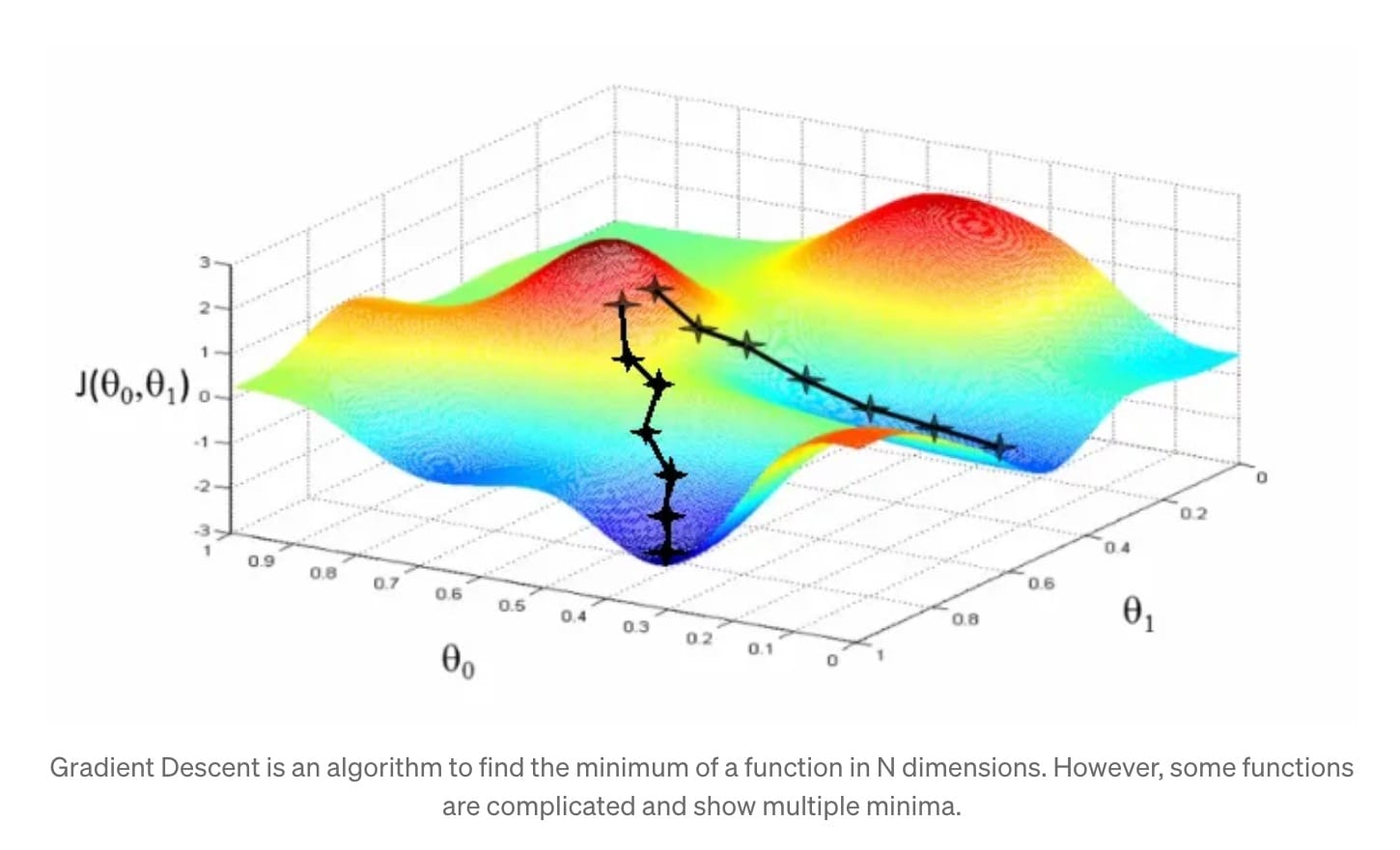
Each step nudges the system toward local maxima in the distribution learned from the internet. Different temperatures added noise to the path, but didn't change the destination. In fact, pooling reduced the number of distinct clusters, making it even more meh. Why? Because the underlying training data constraints were what was binding, not the parameters.
There is a human analogue here, of course. Stories passed on from memory have always drifted toward shared cognitive biases. Flood myths, for example, recur cross-culturally. But there is a difference. Humans have corrective feedback: dialogue, disagreement, intent, etc.. AI feedback loops ... don’t. They’re pure transmission, amplifying whatever statistical patterns are frozen into their training data.
This generalizes well beyond art and images. Anywhere models evaluate or reinforce their own outputs, like in agentic systems, the same dynamics apply: language models refining their own reasoning, trading algorithms reacting to each other’s signals, recommendation systems driving over-crowding in tourism. These are feedback loops in high-dimensional probability spaces, each with its own attractor basins.