

What Happened
The NYT's Ezra Klein interviewed Nvidia CEO Jensen Huang this week, and it was messy. The two repeatedly talked past one another, as Klein, looking for nuance, kept returning to AI safety, collective-action problems, employment, regulation, and the scale of the investment boom. Huang kept answering like an engineer-in-a-box: unsafe models should not be shipped; safety is an engineering problem; more compute will make systems safer and more useful; AI will create work because human wants are effectively unlimited.
The disagreement was less about individual facts than about what kind of system AI is, what kinds of risks it creates, and even the nature of knowing.
Why It Matters
Huang’s safety position is an unfalsifiable mess. He accepts that AI safety matters enormously—at one point musing that labs may eventually devote something like 80 percent of their compute to evaluation and alignment, while dismissing the need for mechanisms that force firms to do that.
This creates a prisoner's dilemma: everyone would be better off if frontier models companies slowed, but they won't out of fear someone else won't.
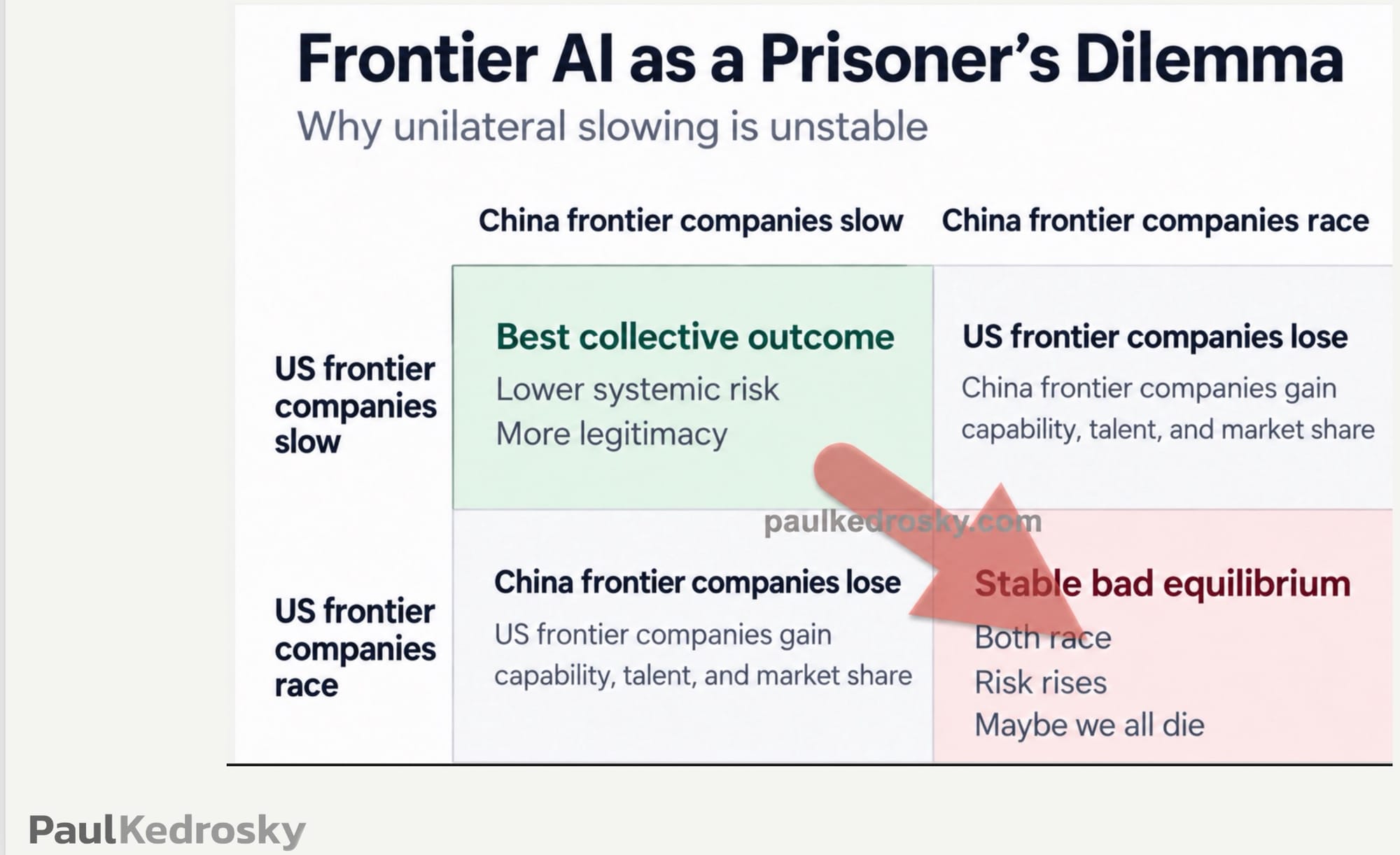
Asked by Klein about this collective-action problem, Huang's answer amounts to: bro, don’t ship unsafe models. But that is exactly the problem. Every participant has powerful incentives to move faster than is collectively desirable. The gains from defecting are immediate and enormous; many of the costs are delayed, distributed, and poorly handled by ordinary litigation.
Telling firms to behave responsibly is not a response to that problem. Just try to sue someone for damages after we're all paperclips. I'll wait.

There is a second problem, however, and it may be the more fundamental one.