

Almost two years ago, when we began writing and speaking in a more focused way about the current episode, many with whom we spoke and corresponded wanted and lacked a proper framing. We usually offered two, the second of which we focus on today because it is particularly instructive given current events.
- The first is that this episode can be usefully thought of in the historical context of prior capex paroxysms, from canals and railroads, to electrification, to the financial crisis and fiber optics. All of these had in common massive amounts of capital being redirected to some new infrastructure—sometimes a GPT (general purpose technology). It was usually more than could be justified, causing massive financial losses, even if the asset itself was often useful in the long run.
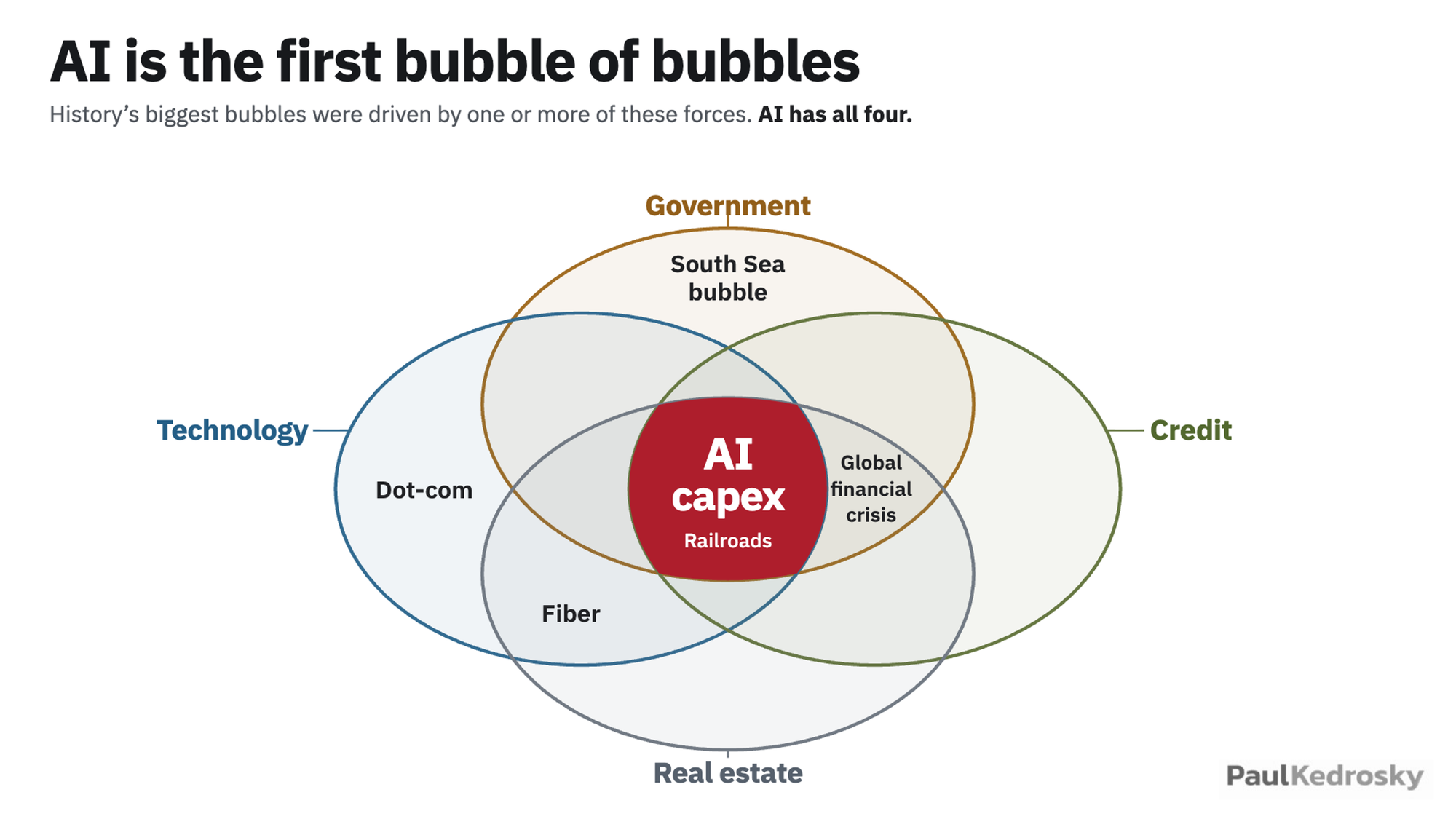
- Most Western financial bubbles are driven by one or more of four forces: government, technology, real estate, and credit. The GFC, for example, was at the intersection of government policy and credit—governments wanted more home ownership, and capital markets found innovative ways to expand lending. The fiber moment was at the intersection of real estate and technology. The South Sea bubble was largely about government policy.
The current moment is unusual in that is at the intersection of all four bubbleish forces, having credit, government, real estate, and technology drivers. That makes it historically rare, perhaps only comparable to the railroads, albeit happening much faster and at a larger scale in a more interconnected world.
Here is how we usually show this second framing in diagrammatic form:
Why This Model Matters
One reason this matters is that it causes events to accelerate, no different than having motors on all four wheels of your EV. The torque can be intense, economically speaking.
Another is that it can lead to rational bubbles, where participants all feel as if they are acting rationally within their respective domains, and yet the confluence of their actions creates something dramatic and surprising, at least to people not thinking in systems.
The third reason is that it tells you why failure is over-specified: there are myriad ways to fail when triggers can be spread across four domains. And, in particular, it tells you that people will almost certainly be looking in the wrong places, given that they can find seductive historical parallels in each force domain.
What It Tells About Current Events and Fragility
Clients often ask us what we've gotten wrong or revised our views about. And that is a longer topic for another day, even if our general sense of what would happen has largely matched developments. Having said that, one thing we got wrong, and that is a surprise to us, given we kept using the above model, is how intertwined this would become with government and how that would induce fragility.