

Like many historical capex paroxysms, the data center boom can be modeled as a hybridized public-private stimulus program. Hyperscalers supplied the capital. Governments supplied much of the economic and policy support: accelerated depreciation, tax credits, subsidies, property-tax abatements, permitting, interconnect, power access, and contracts. And the result, as we repeatedly pointed out, was that AI capex became a material fraction of GDP growth.
This helps explain why the excesses haven't been as obvious in the usual places, like equity valuations and credit markets: Spending supported by public policy faces different return hurdles. Lenders were underwriting, in part, the continuation of that support.
As we have long argued, the risk was always overdetermined and political.
And now policy is changing, as we (re-)documented over the last two days (see here and here), and as the following figure of ours shows.
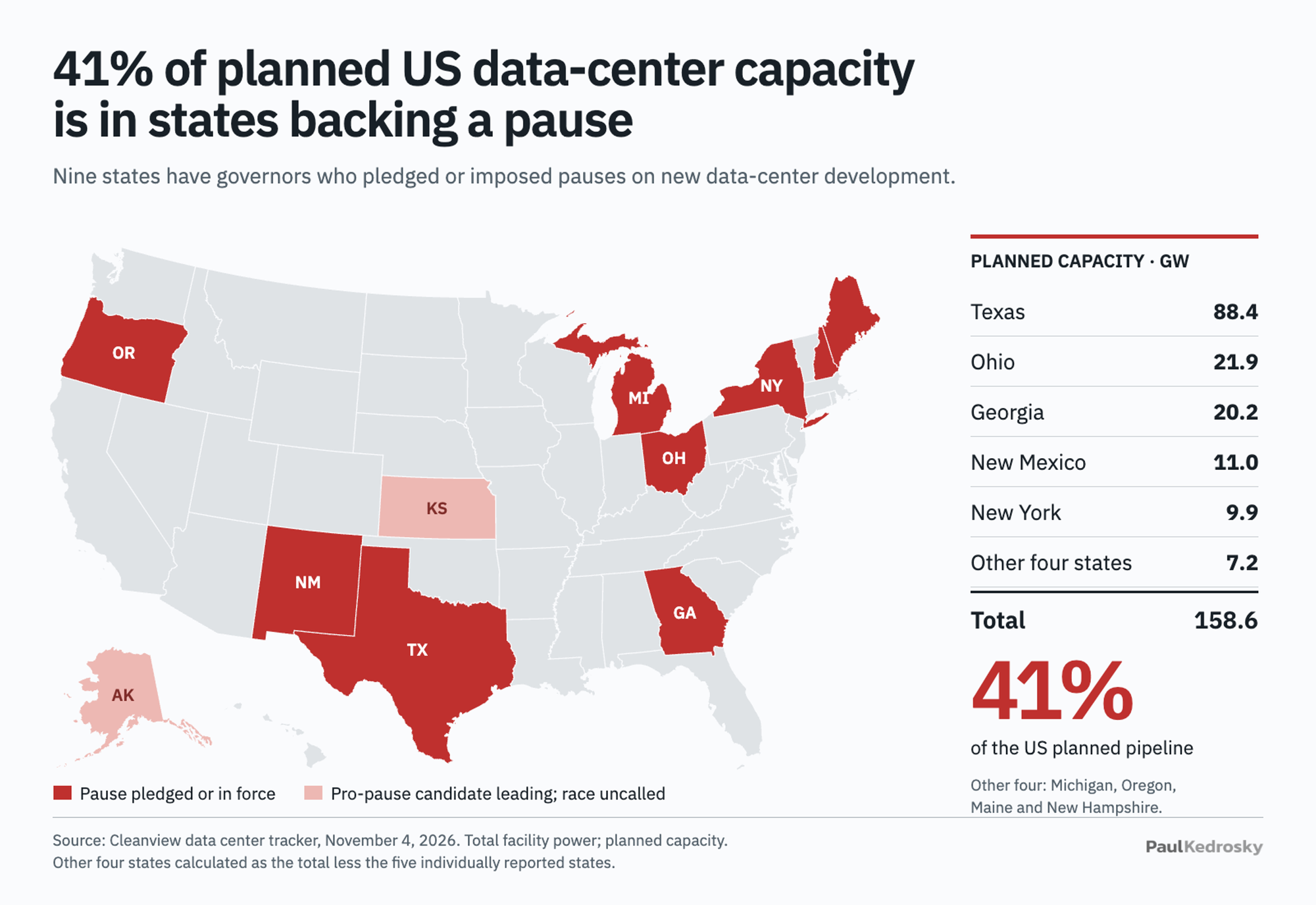
Tuesday's midterms shifted control of congressional committees overseeing taxes, spending, and regulation. More strikingly, voters rejected 44 of 45 data center measures on ballots nationwide.