

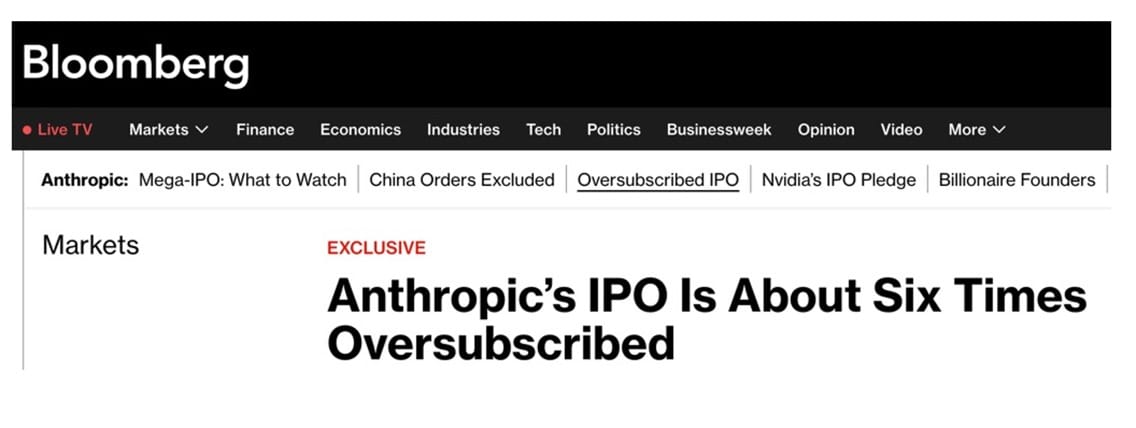
Media outlets are reporting that Anthropic's imminent IPO is six (or maybe seven!) times oversubscribed. In other words, there are vastly more orders than there is stock available. Whoa!
Not so "Whoa". IPO oversubscription is largely an underwriter-manufactured marketing statistic. Banks determine the offering size, help set the price, solicit orders, control allocations, and then leak the result. In that world of engineered demand, any IPO that isn't oversubscribed is an IPO that doesn't happen.
Institutional investors routinely submit orders for more stock than they want because they know the game: they expect to receive only a fraction of what they asked for. And because they know the indication isn't binding—I once bid for the entire Facebook IPO (but didn't get it)—they cheerily LARP along. The resulting "oversubscription" is almost meaningless as a measure of genuine investment demand.
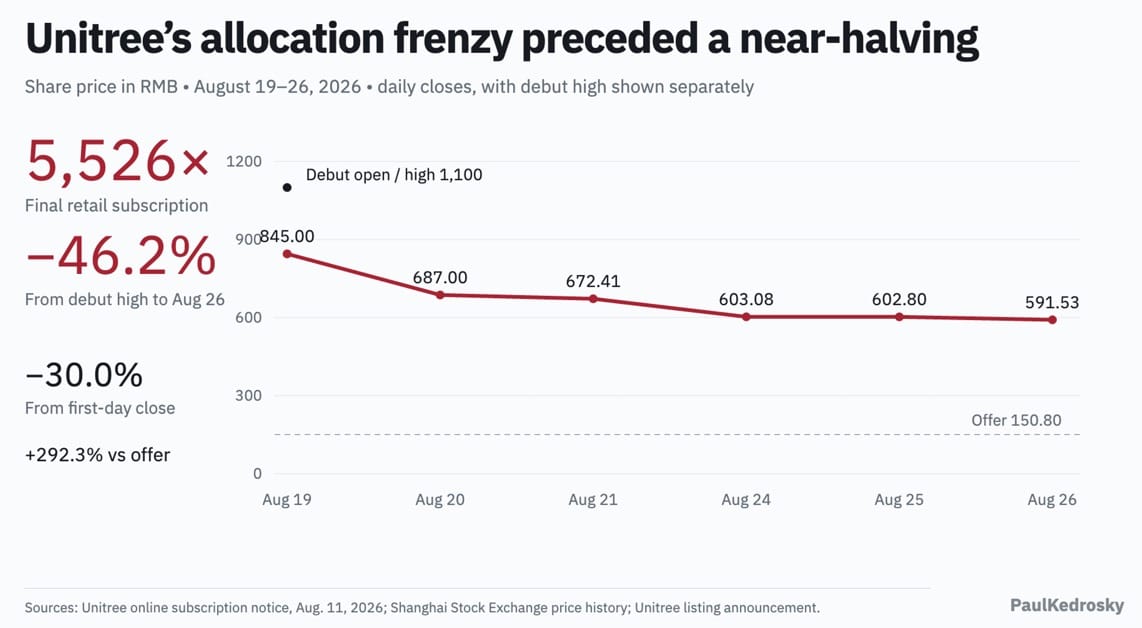
For an extreme case, consider Unitree, the Chinese robotics company that went public in August of this year. Its IPO was 5,526 times oversubscribed among retail investors. Shares opened nearly five times above the offering price, briefly reaching RMB 1,100.
Within a week, the stock had fallen 46% from its opening high and 30% from its first-day close. It was still nearly four times the offering price, but anyone purchasing in the aftermarket lost money.
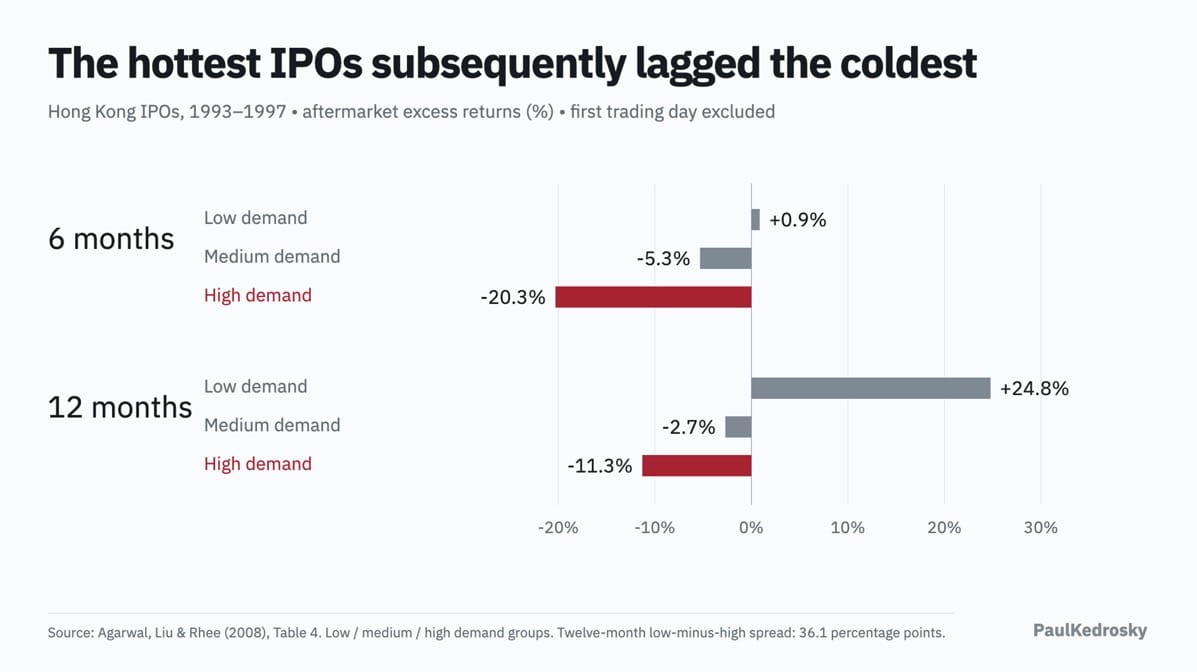
This is a familiar pattern. Researchers behind a 2008 paper studied 256 Hong Kong IPOs between 1993 and 1997, grouping them by subscription demand. The most heavily subscribed offerings generated average first-day returns of 60%, compared with 14.9% for medium-demand offerings and negative 6.7% for low-demand offerings.
Subsequent performance was almost the exact reverse. Six months later, high-demand IPOs had lost an average 20.3% in aftermarket trading, compared with a 0.9% gain for low-demand offerings. At twelve months, the high-demand group was down 11.3%, while the low-demand group was up 24.8%.
That's a 36.1-percentage-point difference in twelve-month returns. The hottest IPOs subsequently performed the worst. This result has since been replicated in IPO markets worldwide.
Let's now turn back to Anthropic's reported demand and that oversubscription thing. Google Trends data show US search interest in "Anthropic IPO" running at roughly one-third that of "SpaceX IPO" at the point in its offering cycle. The Anthropic IPO hasn't even attracted as much interest as the long-delayed "GTA VI" video game, which comes out the same day.