

WILLARD
Who's the commanding officer here?
SOLDIER (firing blindly)
Ain't you?!
Apocalypse Now (1979)
We have written here previously about the changing nature of Anthropic's business, as shown in the S-1, as it shifts from relying on distribution (via its hyperscaler competitors) and leasing compute, to going direct and expensively building more of its own data centers.
But that is not the only way in which Anthropic has been transformed in the last year. The other way, and it is as important, if less visible, is its workforce.
There are two dimensions, both of which are driven by growth and commercial aspirations: median tenure and composition.
Median tenure
Given the company's young age and rapid workforce growth, it is mathematically straightforward to model its shrinking median tenure, measuring half of the employees have been there longer than this, and half shorter.
By our math, Anthropic's median employee tenure is around nine months. That is remarkable, and transformative with respect to workforce culture, given how likely it is that if you sample two people at random, one of them is highly likely to have only just joined.
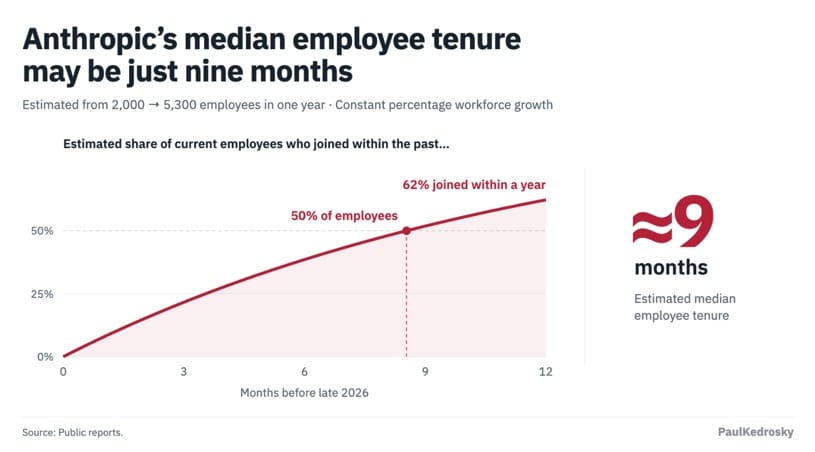
While this is true in any fast-growing company, it is more consequential in one that claims to be mission-driven, like Anthropic, and one in which recency dictates stock payoff to an unprecedented degree.
On the first point, mission is a function of its people, half of whom have been there less time than it takes a pregnant woman to carry a baby to full term. This creates immense pressure, which we have seen over and over in technology companies, like Google, which rapidly lost whatever it was ("Don't be evil") that initially made them unusual.
The collapsing median employee tenure also has financial consequences. Join a year ago, and you are a newly-minted deci-millionaire or more; join in the last nine months, and you can pay off your mortgage. The hypergrowth in valuation has created a culture of financial haves (got stock over a year ago) and have-nots (have stock at much higher prices). This rarely works out swimmingly.